How to Protest Insorrect Google Reviews on My Website
How to get your website to the top of Google
This article first appeared in event 238 of .net magazine – the world'southward best-selling mag for spider web designers and developers.
Certain, yous know about SEO. You might not exist an expert, per se, but y'all take a good agreement of the basics: championship tags, make clean URLs, text-based design and and so on.
Even if you're more of an skillful than about, only every bit ofttimes information technology's what you don't know about SEO that volition hurt you.
Many webmasters institute this out the hard way in February 2011, when Google's Panda update was released. Many of these same webmasters were hit again little more than a twelvemonth after, when the search behemothic's Penguin update followed – targeting low-quality, spammy link-edifice tactics. What they idea was SEO worked for a piddling while, so turned out to exist less than optimal. Sites were penalised; traffic and revenue lost, and then-chosen 'SEOs' fired.
Since and then there's been a new tone in the SEO industry. Not all of usa were creating low-quality content and links; merely for many of those that were these ii updates were a wake-up call. And for those of us who have always been focused on high-quality, relevant content and links, it was something like redemption. Our sites soared while so many fell.
This is the new normal for SEO. Yes, there are still some who call themselves SEOs but focus on manipulative tactics with short term revenue goals; withal at that place are likewise many who are part of a large and growing industry of specialists in a highly complex discipline that requires marketing, technical, and inquiry and advice skills.
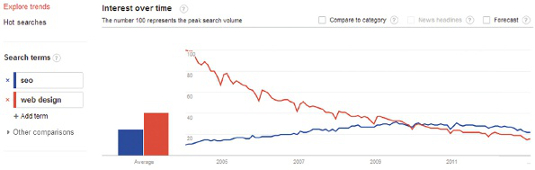
So just how large is SEO? Believe it or not, it'due south bigger in the minds of Google searchers than web design. One time considered a subset of spider web design, searches for SEO now eclipse those of spider web design worldwide.
The total projected value of the North American search marketing manufacture (SEO and paid search) in 2013 is $26.8billion, according to industry trade system SEMPO, and 13 per cent of companies take SEO budgets of half a million to more than three million a year (up from 8 per cent in 2011).
As budgets increase, in that location's more to lose, and many companies accept become more run a risk averse – forgoing the shady tactics they may have pursued in the past.
In cutting out the garbage nosotros start to encounter what SEO is really good for (and has always been practiced for): connecting relevant content with relevant searchers, and making content discoverable through accessibility and marketing.
For those of you who still think of SEOs as greasy algorithm-chasers in cheap suits or parents' basements, consider the new reality.

Engines are not enemies
When I started doing SEO in-house for a Fortune fifty corporation 10 years ago, there were many in the arrangement who were a little nervous about what we were doing. Nothing was confronting the Google guidelines … considering there were no such guidelines in existence. At that fourth dimension there were a few books, merely SEO was largely something that was spoken of covertly, and certainly never to search engines, which, it was thought, would likely think of it as manipulation.
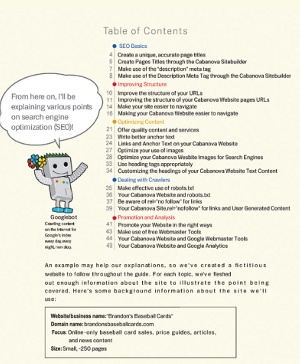
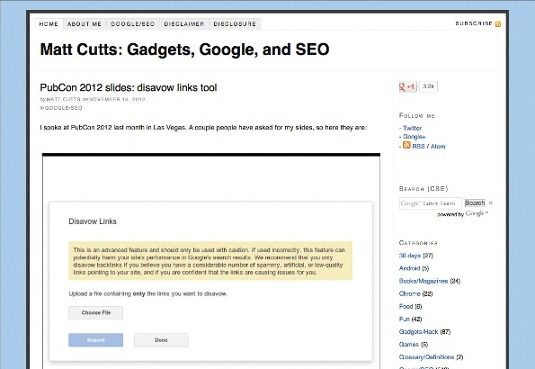
Today we know ameliorate. Google and Bing have both published all-encompassing webmaster guidelines, and Google has even published a guide to SEO for beginners. In August 2011 Matt Cutts, Google'due south head of webspam, released a video statement proverb that Google does non consider SEO by itself to exist spam. This sentiment now appears in Google'due south definition of search engine optimisation, in which it says: "Many SEOs and other agencies and consultants provide useful services for website owners."
Yet, considering of a few spammers who call themselves SEOs, SEOs in general have the reputation of beingness charlatans, and have been portrayed as such on television shows such as The Practiced Wife and Dexter.
"SEO has unfortunately got a bad rap, and information technology's due mainly to questionable SEO practitioners who perpetuate the 'snake oil' stereotype past making customers believe at that place'southward some magic 'black box' that 'tricks' the search engines," says Gord Hotchkiss, chief strategy officer for Montreal-based Mediative and regular columnist for Search Insider. Hotchkiss, and the other experts I reach out to for this commodity, explain that SEO is simply about getting relevant content indexed, and making sure information technology'south visible to the search engines.
All of the veteran SEOs that I speak to understand why SEO still has the reputation in some circles of being snake oil. Only they insist that it has, at this betoken, become much more mainstream and credible.
Rand Fishkin, founder of Seattle-based SEO software company SEOMoz, discusses with me a few of his favourite reasons for SEO being something other than snake oil, including that "SEOmoz itself has more than 2million monthly visits, nearly all from spider web marketers looking to learn more about the exercise. And our software, which bills monthly, has more than eighteen,000 subscribers as of today. If SEO were just snake oil, I strongly doubtable folks would terminate paying."
SEO, in its legitimate grade, is now a more accustomed part of the web design process, and in many organisations is finally getting a seat at the tabular array when information technology comes to designing professional, search engine-friendly spider web sites.
A procedure, non a project
In my decade-plus doing enterprise SEO there have been many instances in which the SEO squad is brought in after the website is already complete, and told to magically arrive search engine friendly. This isn't ideal. As Google says in its guide to SEO: "If yous're thinking about hiring an SEO, the earlier the better."
The really competitive sites that I've worked with over the years empathise this, and integrate SEO into every stage of their planning process, from information architecture to content strategy to design, evolution, launch and postal service-launch.
A lot of web designers and developers are hesitant nearly integrating SEO further into the process, because doing and so effectively produces extra piece of work. But the rewards can be great, reminds Vanessa Flim-flam, founder and CEO of Ix by Blue and author of Marketing in the Historic period of Google. "Organisations are losing 1) tremendous insight into their customers and potential customers if they don't accept advantage of the costless search data that'southward bachelor from the millions of searches we do each day; 2) the opportunity to reach a significantly larger audience through being visible in search results."
Would you put the Mona Lisa in a closet? Would yous spend hours cooking Beef Wellington, and as it emerges perfect from the oven throw it in the trash? And so why would you build a website without because how it will be found?
In that location's another reason for making SEO a priority in the web pattern process, advises Hotchkiss – "it forces you to create a better website! Good SEO optimisation should be baked into your information architecture. Information technology volition force yous to retrieve about common content themes. It requires you to consider how all digital avails (such as videos and user-generated content) will exist integrated into the overall user experience. Information technology helps eliminate user feel dead ends such as gratuitious Flash interfaces and, my personal pet peeve, content locked in PDFs. It extends your perception of your online footprint beyond the bounds of your website, including things similar social media. Information technology volition likewise instil a good for you rigour when information technology comes to thinking about how your site links together. Adept SEO practices means a better user experience."

From my experience, more organisations than ever are learning these lessons, and are no longer thinking of SEO equally a project, but every bit an ongoing process that ensures a website will be as visible in search equally possible. This is skillful for web blueprint because it gives information technology a larger audition, but as well practiced for business.
It's not simply most links: emerging SEO trends
While many commentators have claimed that SEO is dead since information technology began effectually 1997, the truth is that information technology doesn't dice; information technology evolves with the search engines. While SEO is constantly evolving, at the moment information technology seems focused on mobility, utility, the audience and automation, among other things.
One of these trends is the dissolving stardom betwixt SEO, user experience and content strategy. In i recent Webmaster Tools YouTube video, Matt Cutts even suggested that those looking to alter the proper name might consider "searcher experience optimisation" to differentiate from the snake oil diversity of SEO.
Some, such as Vanessa Fox, have suggested that SEO need non continue as a split up activity from UX and content strategy: "I think that both disciplines should incorporate best practices from search rather than thinking of it as something tacked on later," she says. "Peculiarly, the data available from search is extremely valuable. Also, understanding that many visitors begin with a major search engine and that any page of the site can therefore become the home folio of the site can shift how we look at both folio design and content."
At the aforementioned time, Fox – and all of the other SEOs I asked – recognise that content strategy and usability, while essential for reputable SEO, need technical and other elements from SEO to exist useful equally a way of getting incremental search engine traffic.
"When SEO is done the right style, usability and content is a huge role of the programme," opines Eric Enge, founder and CEO of Massachusetts-based Stone Temple Consulting and co-writer of The Fine art of SEO. "This is something that the snake-oil SEO people don't worry nearly. For long-term success as a web publisher, the use must come first. Even so, for success every bit a concern, you need to do more than."
With this concentration on content strategy and usability comes a focus on the audience likewise. For Hotchkiss, this is a shift from word-matching to utility, and follows the search engines' own evolution. "Today, skillful SEO is about making certain that when a prospect uses a word (or words) to search for something, yous match that equally best as possible," he says. "But in the future, SEO will be about ensuring that when your prospect wants something, you lot deliver it. It may not be content. It may be a movie ticket, a hotel booking, a eating house reservation or a downloaded TV prove."
A modify in assay
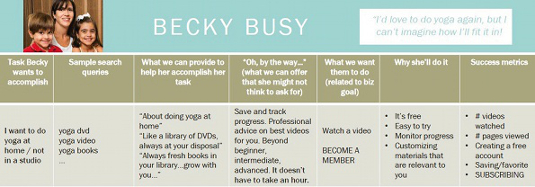
Delivering on this promise oft requires a new blazon of analysis. In the past, marketers have done keyword research to uncover keywords equally proxies for user intent. In Marketing in the Historic period of Google, Vanessa Fox describes the process of creating searcher personas that get beyond simple keyword matching and search volume exercises. And still others, such as iCrossing's Core Audience and Resolution Media's ClearTarget endeavour to sympathize characteristics of audiences, including but non limited to the keywords that they employ.
For some businesses, mobility will not change user intent. For example, news is non going to exist rewritten for a separate platform, as Karen McGrane and other adaptive content advocates frequently signal out. Notwithstanding, for some businesses it does; and if marketers desire to get the nigh traffic and conversions from the mobile platform (in other words, be optimised for) the devil is in the particular, and understanding potential differences betwixt mobile and desktop audiences is key.
In that location are technical considerations as well, which make a blazon of SEO geared towards these differences – what is commonly called mobile SEO – what it is. Many people in the SEO world, as with their counterparts in the design earth, believe that responsive design is the answer to these differences – and Google stated a preference for responsive design in June. Even so, as I said in issue 232 of .net, responsive blueprint is non always best for the user, and Google wouldn't prefer it in those cases. If mobile and desktop search behaviour is significantly different, Google supports using dynamic serving or switchboard tags besides.
Cindy Krum, CEO of Denver-based mobile marketing agency Mobile Moxie and writer of Mobile Marketing: Finding Your Customers Wherever They Are agrees that responsive design is 1 of many solutions for mobile SEO. "I have been recommending a mixed solution for almost of my clients," she says, "leveraging responsive design when it makes sense, and special mobile-simply landing pages when keywords or employ-cases cannot be appropriately addressed with a responsive design approach."
Another big shift in SEO has been the introduction of more automation to the process. SEO software has been around equally long equally SEO has (retrieve WebPosition Gold?), but the breadth of tools and level of composure has increased considerably in the last yr or two.
Now there are tools to help you optimise the long-tail through semantic relevance (BloomReach), reporting tools (Conductor, BrightEdge, SEOMoz)), link building tools (Ontolo, Ahrefs, Open Site Explorer, Majestic SEO) and more, all geared toward automating aspects of the SEO process (run into our superlative 20).
When this happens, inevitably someone in the press will merits that the tool will allow yous to fire your redundant SEO; merely none of the SEO experts or software providers I talk to concur. "Great SEO starts with human beings who are artistic, tenacious, and compassionate to the needs of searchers," says Fishkin. "No software tin can ever automate those processes."
There are other trends in SEO that are important, amongst them the integration of social signals into ranking algorithms and SEO that is not but text-based, but about understanding and optimising images and videos – perhaps eventually for article of clothing computing purposes (Google Glass, for example). All in all, legitimate SEO has evolved with the search engines – and information technology continues to do so. As I've said, understanding and applying this new information requires a new type of SEO practitioner, and a different kind of user-focused SEO. The next fourth dimension someone tells you something unlike, you now take the knowledge to ready them direct.
How to transport big files to clients: discover viii free tools
Related articles
Source: https://www.creativebloq.com/how-get-your-website-top-google-6133899
0 Response to "How to Protest Insorrect Google Reviews on My Website"
Post a Comment