Stop Calling It Baby Fat When Your Baby Is Four Years Old
If your child is overweight when they start school at the age of 6, unless you practise something about it at that point, the indications are that they are going to be overweight teenagers and obese adults.
Bear witness has shown that overweight children and teenagers accept a greater take a chance of developing lifestyle diseases such as blazon 2 diabetes, hypertension and cardiovascular disease later in life - and dying prematurely.
Obesity is a global pandemic rapidly spreading among adults and children, in developed and developing countries alike.
Our study has found that children who are overweight past the time they turn half-dozen should be screened for weight problems. This should be done in a sensitive, not-stigmatising way.
Why six-year-olds?
Children who are overweight betwixt the ages of two and 5 are five times more than probable to be overweight when they are 12.
There are two periods in a normal life wheel when the trunk makes new fat cells. The showtime is in the uterus and the second is effectually the age of six-years-old. The 2nd phase lasts from the age of six to puberty.
Exterior these periods, our trunk's existing fat cells are fixed and swell out or compress equally we gain or lose fatty.
In lean toddlers, their fat cells gradually shrink in the course of their early childhood. Past the fourth dimension they turn 6-years-old, their body's fatness is at its lowest point and it can then kickoff reproducing fat cells until puberty when fat cells stop forming.
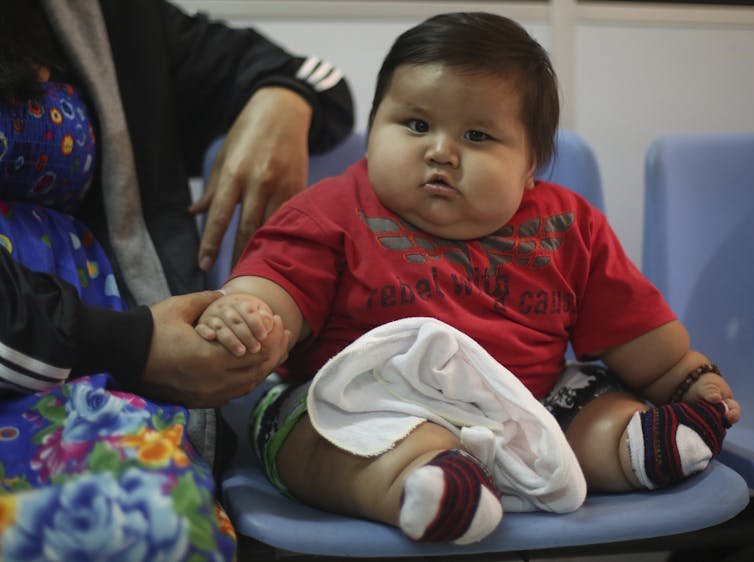
But for obese toddlers, the second phase starts earlier they plow six and their bodies make pronouncedly more fat cells than lean children'due south bodies. The result is that obese toddlers get obese adolescents with much more than fatty cells than the child who started out with a normal weight at six.
A fat finding mission
The study assessed the prevalence of obesity in six-twelvemonth-olds every bit part of a campaign in South Africa to raise sensation of the problem amid parents and educators.
A total of 99 children were called from seven schools in Mangaung, the capital urban center of Free State province. The schools were chosen from quintile four and five schools, which when measured by their own resources and economic circumstances are well resourced and serve largely middle class and wealthy communities.
The children's weight, superlative and waist circumference were measured and used to calculate a trunk mass index score and waist-to-height ratio. Both these figures are skilful predictors for future lifestyle disease risks such every bit blazon 2 diabetes, hypertension and cardiovascular affliction. A person with a good waist-to-height ratio tin wrap a slice of string equal to their height around their waist at least twice.
When the children had higher body mass indexes, they also had an increased waist to summit ratio.
The study found that one in four children from the schools surveyed were overweight when they started primary schoolhouse.
The but other Due south African study to wait at child obesity is the Southward African National Health and Diet Examination Survey. It surveyed children betwixt the ages of six and nine. Its 2012 results showed a lower national average than the Mangaung survey which surveyed only 6-year-olds.
Nipping the fat in the bud
Although there are many factors that play a role in preventing childhood obesity, parents' perceptions of their children'south weight play an important part. A recent meta-analysis of 69 studies found that more than 50% of parents underestimate the weight of their obese children. These parents remain unaware of the risks their children's confront and are also unmotivated to take any action.
At to the lowest degree one-half of the parents whose children are overweight struggle to recognise their children'south weight issues fearing that they volition be labelled or stigmatised.
To get involved, parents must commencement acknowledge the problem.
Interventions aimed at preventing obesity in the pre-school years should exist a priority for parents. Parents have to be involved in these interventions as they play a crucial role in modelling and establishing children's dietary and physical activeness patterns.
By the time they turn 6, overweight children should be referred to dieticians and nutritionists who are qualified to guide their parents in getting them to eat well and be more physically active at pre-master and primary schools.
The high prevalence of weight problems among six-year-olds institute in this study is an urgent call to wellness intendance professionals to step upward and empower parents, educators and children with the necessary skills for healthy dietary practices and adequate physical activity.
Source: https://theconversation.com/dont-believe-your-childs-baby-fat-will-melt-away-with-age-42213
0 Response to "Stop Calling It Baby Fat When Your Baby Is Four Years Old"
Post a Comment