Sparkles Family Fun Center of Smyrna Smyrna, Ga
| Σμύρνη / Σμύρνα (Aboriginal Greek) | |
 The Agora of Smyrna (columns of the western stoa) | |
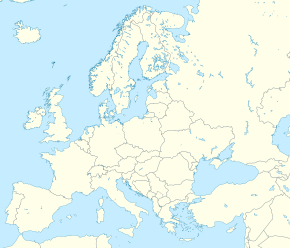
| Shown within Turkey Show map of Turkey Smyrna (Europe) Show map of Europe | |
| Location | İzmir, İzmir Province, Turkey |
|---|---|
| Region | Ionia |
| Coordinates | 38°25′vii″N 27°8′21″E / 38.41861°Due north 27.13917°E / 38.41861; 27.13917 Coordinates: 38°25′7″North 27°8′21″E / 38.41861°Due north 27.13917°E / 38.41861; 27.13917 |
| Type | Settlement |



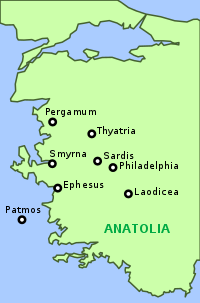
Smyrna amid the cities of Ionia and Lydia (ca. 50 AD)
Smyrna ( SMUR-nə; Ancient Greek: Σμύρνη, romanized: Smýrnē , or Ancient Greek: Σμύρνα, romanized: Smýrna ) was a Greek city located at a strategic point on the Aegean coast of Anatolia. Due to its advantageous port conditions, its ease of defence, and its good inland connections, Smyrna rose to prominence. The name of the city since almost 1930 is İzmir.[one]
2 sites of the ancient city are today within Izmir'south boundaries. The first site, probably founded past indigenous peoples, rose to prominence during the Archaic Catamenia equally one of the principal ancient Greek settlements in western Anatolia. The second, whose foundation is associated with Alexander the Cracking,[ii] reached metropolitan proportions during the period of the Roman Empire. Nearly of the present-twenty-four hours remains of the aboriginal city appointment from the Roman era, the majority from after a second-century Ad convulsion. In applied terms, a stardom is oftentimes made between these. Old Smyrna was the initial settlement founded effectually the 11th century BC, start every bit an Aeolian settlement, and later taken over and developed during the Primitive Menstruum past the Ionians. Smyrna proper was the new city which residents moved to as of the fourth century BC and whose foundation was inspired by Alexander the Corking.[2]
Old Smyrna was located on a small peninsula connected to the mainland by a narrow isthmus at the northeastern corner of the inner Gulf of İzmir, at the edge of a fertile evidently and at the pes of Mountain Yamanlar. This Anatolian settlement allowable the gulf. Today, the archeological site, named Bayraklı Höyüğü, is approximately 700 metres (770 yd) inland, in the Tepekule neighbourhood of Bayraklı. New Smyrna developed simultaneously on the slopes of the Mountain Pagos (Kadifekale today) and alongside the coastal strait, immediately beneath where a small bay existed until the 18th century.
The core of the late Hellenistic and early on Roman Smyrna is preserved in the large area of İzmir Agora Open Air Museum at this site. Research is being pursued at the sites of both the one-time and the new cities. This has been conducted since 1997 for Old Smyrna and since 2002 for the Classical Flow city, in collaboration between the İzmir Archaeology Museum and the Metropolitan Municipality of İzmir.[3]
History [edit]

The agora of ancient Smyrna
Etymology [edit]
Several explanations have been offered for its name. A Greek myth derived the proper name from an eponymous Amazon named Σμύρνα (Smyrna), which was also the proper noun of a quarter of Ephesus. This is the ground of Myrina, a urban center of Aeolis.
In inscriptions and coins, the proper noun often was written as Ζμύρνα (Zmýrna), Ζμυρναῖος (Zmyrnaîos, "of Smyrna").[4]

Arches of the ancient city of Smyrna
The proper name Smyrna may as well have been taken from the aboriginal Greek word for myrrh, smýrna,[v] [vi] [7] which was the principal export of the city in aboriginal times.[8]
Third millennium to 687 BC [edit]
The region was settled at least every bit of the commencement of the third millennium BC, or perhaps earlier, as suggested by finds made in Yeşilova Höyük in excavations since 2005. It could have been a city of the autochthonous Leleges earlier the Greek colonists started to settle forth the declension of Asia Minor at the turn of the second to beginning millennium BC. Throughout classical antiquity, Smyrna was a leading city-state of Ionia, with influence over the Aegean shores and islands. Smyrna was too amid the cities that claimed Homer every bit a resident.[ix]
The early on Aeolian Greek settlers of Lesbos and Cyme, expanding eastwards, occupied the valley of Smyrna. It was one of the confederacy of Aeolian city-states, marking the Aeolian frontier with the Ionian colonies.
Strangers or refugees from the Ionian city of Colophon settled in the urban center. During an uprising in 688 BC, they took command of the city, making it the thirteenth of the Ionian urban center-states. Revised mythologies said it was a colony of Ephesus.[x] In 688 BC, the Ionian boxer Onomastus of Smyrna won the prize at Olympia, simply the coup was probably so a recent result. The Colophonian conquest is mentioned past Mimnermus (before 600 BC), who counts himself equally of Colophon and of Smyrna. The Aeolic form of the name was retained fifty-fifty in the Attic dialect, and the epithet "Aeolian Smyrna" remained current long after the conquest.

Agora of Smyrna, congenital during the Hellenistic era at the base of Pagos Hill and totally rebuilt under Marcus Aurelius after the subversive 178 AD convulsion
Smyrna was located at the mouth of the pocket-size river Hermus and at the head of a deep arm of the bounding main (Smyrnaeus Sinus) that reached far inland. This enabled Greek trading ships to sail into the eye of Lydia, making the urban center office of an essential trade road betwixt Anatolia and the Aegean. During the seventh century BC, Smyrna rose to power and splendor. One of the great trade routes which cross Anatolia descends the Hermus valley past Sardis, and and so, diverging from the valley, passes south of Mount Sipylus and crosses a depression pass into the lilliputian valley where Smyrna lies between the mountains and the body of water. Miletus and later Ephesus were situated at the sea end of the other cracking trade route beyond Anatolia; they competed for a time successfully with Smyrna; but after both cities' harbors silted upwards, Smyrna was without a rival.
The Meles River, which flowed past Smyrna, is famous in literature and was worshiped in the valley. A mutual and consistent tradition connects Homer with the valley of Smyrna and the banks of the Meles; his figure was one of the stock types on coins of Smyrna, i class of which numismatists call "Homerian." The epithet Melesigenes was applied to him; the cave where he was wont to compose his poems was shown virtually the source of the river; his temple, the Homereum, stood on its banks. The steady equable flow of the Meles, akin in summer and winter, and its short course, beginning and catastrophe near the urban center, are celebrated by Aristides and Himerius. The stream rises from arable springs east of the city and flows into the southeast extremity of the gulf.
The archaic metropolis ("Old Smyrna") independent a temple of Athena from the seventh century BC.
Lydian catamenia [edit]
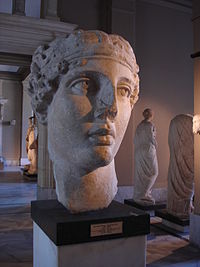

When the Mermnad kings raised the Lydian power and aggressiveness, Smyrna was one of the kickoff points of attack. Gyges (ca. 687–652 BC) was, however, defeated on the banks of the Hermus, the situation of the battleground showing that the power of Smyrna extended far to the east. A strong fortress was built probably by the Smyrnaean Ionians to command the valley of Nymphi, the ruins of which are still imposing, on a hill in the pass between Smyrna and Nymphi.
According to Theognis (c. 500 BC), it was pride that destroyed Smyrna. Mimnermus laments the degeneracy of the citizens of his day, who could no longer stem the Lydian advance. Finally, Alyattes (609–560 BC) conquered the metropolis and sacked it, and though Smyrna did non stop to exist, the Greek life and political unity were destroyed, and the polis was reorganized on the village arrangement. Smyrna is mentioned in a fragment of Pindar and in an inscription of 388 BC, but its greatness was past.
Hellenistic catamenia [edit]
Alexander the Great conceived the thought of restoring the Greek city in a scheme that was, according to Strabo, actually carried out under Antigonus (316–301 BC) and Lysimachus (301 BC—281 BC), who enlarged and fortified the urban center. The ruined acropolis of the ancient metropolis, the "crown of Smyrna", had been on a steep superlative about 380 metres (i,250 ft) high, which overhangs the northeast extremity of the gulf. Modern İzmir was constructed atop the later Hellenistic city, partly on the slopes of a rounded colina the Greeks called Pagos [11] nigh the southeast end of the gulf, and partly on the low ground between the hill and the sea. The dazzler of the Hellenistic city, clustering on the low footing and ascension tier over tier on the hillside, was frequently praised past the ancients and is historic on its coins.

The statue of the river god Kaystros with a cornucopia in Izmir Museum of History and Art at Kültürpark
Smyrna is shut in on the west by a hill now chosen Deirmen Tepe, with the ruins of a temple on the meridian. The walls of Lysimachus crossed the summit of this hill, and the acropolis occupied the top of Pagus. Between the two the road from Ephesus entered the city past the Ephesian gate, almost which was a gymnasium. Closer to the acropolis the outline of the stadium is still visible, and the theatre was situated on the northward slopes of Pagus. Smyrna possessed two harbours. The outer harbour was simply the open roadstead of the gulf, and the inner was a pocket-sized basin with a narrow entrance partially filled up by Tamerlane in 1402 AD.
The streets were broad, well paved and laid out at right angles; many were named after temples: the master street, called the Golden, ran across the city from west to east, outset probably from the temple of Zeus Akraios on the due west slope of Pagus, and running round the lower slopes of Pagus (like a necklace on the statue, to apply the favorite terms of Aristides the orator) towards Tepecik outside the city on the e, where probably stood the temple of Cybele, worshipped nether the name of Meter Sipylene, the patroness of the city. The proper noun is from the nearby Mount Sipylus, which bounds the valley of the metropolis'south backlands. The obviously towards the sea was too low to be properly drained, and in rainy weather, the streets of the lower town were deep with mud and water.
At the end of the Hellenistic menstruation, in 197 BC, the urban center all of a sudden cut its ties with King Eumenes of Pergamum and instead appealed to Rome for help. Because Rome and Smyrna had no ties until then, Smyrna created a cult of Rome to institute a bail, and the cult eventually became widespread through the whole Roman Empire. As of 195 BC, the city of Rome started to be deified, in the cult to the goddess Roma. In this sense, the Smyrneans tin can be considered equally the creators of the goddess Roma.
In 133 BC, when the last Attalid king Attalus 3 died without an heir, his will conferred his entire kingdom, including Smyrna, to the Romans. They organized it into the Roman province of Asia, making Pergamum the capital. Smyrna, however, as a major seaport, became a leading city in the newly constituted province.
Roman and Byzantine period [edit]
Equally one of the principal cities of Roman Asia,[12] Smyrna vied with Ephesus and Pergamum for the title "First Urban center of Asia."
A Christian church and a bishopric existed hither from a very early time, probably originating in the considerable Jewish colony. Information technology was one of the seven churches addressed in the Book of Revelation.[13] Saint Ignatius of Antioch visited Smyrna and later wrote letters to its bishop, Polycarp. A mob of Jews and pagans abetted the martyrdom of Polycarp in Advertising 153.[12] Saint Irenaeus, who heard Polycarp as a boy, was probably a native of Smyrna.[12] Some other famous resident of the same period was Aelius Aristides.[14]
After a destructive earthquake in 178 AD, Smyrna was rebuilt in the Roman period (2nd century AD) under the emperor Marcus Aurelius. Aelius Aristides wrote a letter of the alphabet to Marcus Aurelius and his son Commodus, inviting them to become the new founders of the city.[14] The bust of the emperor'south wife Faustina on the second arch of the western stoa confirms this fact.[ citation needed ]
Polycrates reports a succession of bishops including Polycarp of Smyrna, as well equally others in nearby cities such as Melito of Sardis. Related to that time the German historian W. Bauer wrote:
Asian Jewish Christianity received in turn the noesis that henceforth the "church building" would be open without hesitation to the Jewish influence mediated by Christians, coming not only from the apocalyptic traditions, just as well from the synagogue with its practices concerning worship, which led to the cribbing of the Jewish passover observance. Fifty-fifty the observance of the sabbath by Christians appears to have plant some favor in Asia...we find that in post-apostolic times, in the period of the formation of ecclesiastical structure, the Jewish Christians in these regions come into prominence.[fifteen]
In the late second century, Irenaeus also noted:
Polycarp also was not only instructed by apostles, and conversed with many who had seen Christ, only was also, by apostles in Asia, appointed bishop of the Church in Smyrna…always taught the things which he had learned from the apostles, and which the Church has handed down, and which lone are true. To these things all the Asiatic Churches evidence, as practice besides those men who take succeeded Polycarp.[16]
Tertullian wrote c. 208 Advert:
Anyhow the heresies are at best novelties, and have no continuity with the teaching of Christ. Mayhap some heretics may claim Apostolic antiquity: we reply: Let them publish the origins of their churches and unroll the catalogue of their bishops till now from the Apostles or from some bishop appointed past the Apostles, as the Smyrnaeans count from Polycarp and John, and the Romans from Cloudless and Peter; let heretics invent something to match this.[17]
Hence, apparently the church in Smyrna was one of the churches that Tertullian felt had existent apostolic succession.
During the mid-3rd century, nearly became affiliated with the Greco-Roman churches.
When Constantinople became the seat of government, the trade between Anatolia and the W diminished in importance, and Smyrna declined.
The Seljuq commander Tzachas seized Smyrna in 1084 and used it as a base of operations for naval raids, but the city was recovered by the full general John Doukas.
The metropolis was several times ravaged by the Turks, and had become quite ruinous when the Nicaean emperor John 3 Doukas Vatatzes rebuilt it most 1222.
Ottoman menstruum [edit]


Ibn Batuta found it still in nifty part a ruin when the homonymous chieftain of the Beylik of Aydın had conquered it near 1330 and made his son, Umur, governor. It became the port of the emirate.
During the Smyrniote Crusade in 1344, on October 28, the combined forces of the Knights Hospitaliers of Rhodes, the Republic of Venice, the Papal States and the Kingdom of Cyprus, captured both the harbor and metropolis from the Turks, which they held for nearly 60 years; the citadel barbarous in 1348, with the death of the governor Umur Baha ad-Din Ghazi.[18]
In 1402, Tamerlane stormed the town and massacred almost all the inhabitants. The Mongol conquest was merely temporary, but Smyrna was recovered past the Turks under the Aydın dynasty subsequently which it became Ottoman, when the Ottomans took over the lands of Aydın later 1425.[xix]
Greek influence was so strong in the area that the Turks chosen it "Smyrna of the infidels" (Gavur İzmir).[20] While Turkish sources track the emergence of the term to the 14th century when ii separate parts of the city were controlled by two unlike powers, the upper İzmir being Muslim and the lower function of the city Christian.[ citation needed ] [ clarification needed ]
During the belatedly 19th and early on 20th century, the urban center was an of import fiscal and cultural center of the Greek world.[ citation needed ] Out of the 391 factories 322 belonged to local Greeks, while three out of the 9 banks were backed by Greek capital. Didactics was also dominated by the local Greek communities with 67 male person and iv female schools in total. The Ottomans continued to control the area, with the exception of the 1919–1922 catamenia, when the metropolis was assigned to Greece by the Treaty of Sèvres.
The most of import Greek educational institution of the region was the Evangelical School that operated from 1733 to 1922.[21]
Mail World War I [edit]
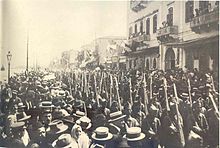
Greek troops marching on İzmir'due south coastal street, May 1919
Subsequently the finish of the Start World War, Greece occupied Smyrna from xv May 1919 and put in identify a military administration. The Greek premier Venizelos had plans to annex Smyrna and he seemed to exist realizing his objective in the Treaty of Sèvres, signed 10 August 1920.[22] (Still, this treaty was not ratified past the parties; the Treaty of Peace of Lausanne replaced it.)
The occupation of Smyrna came to an finish when the Turkish regular army of Kemal Atatürk entered the city on September nine, 1922, at the end of the Greco-Turkish War (1919–1922). In the immediate aftermath, a burn broke out in the Greek and Armenian quarters of the city on September 13, 1922, known equally the Great Burn down of Smyrna. The expiry toll is estimated to range from 10,000[23] [24] to 100,000.[25]
The Armenians, aslope the Greeks, played a significant part in the city'south development, near notably during the age of exploration, where Armenians became a crucial histrion in the trade sector.[26] The Armenians had merchandise routes stretching from the far east to Europe. Ane about notable proficient the Armenians traded was Iranian silk, where the Shah Abbas of Iran gave them the monopoly over it in the 17th century[27] The Armenians traded Iranian silk with European and Greek merchants in Smyrna; this trade made the Armenians very rich. Besides trade, the Armenians were involved in manufacturing, cyberbanking, and other highly productive professions.[26]
After the Armenian Genocide and the Great Fire of Smyrna, the Armenians perished, and the centuries-quondam history and culture that the Armenians had built in Smyrna were eliminated.
Agora [edit]
The remains of the ancient agora of Smyrna plant today the space of İzmir Agora Museum in İzmir's Namazgah quarter, although its area is ordinarily referred to as "Agora" by the urban center'due south inhabitants.
Situated on the northern slopes of the Pagos hills, it was the commercial, judicial and political nucleus of the ancient city, its center for artistic activities and for teaching.
İzmir Agora Open Air Museum consists of five parts, including the agora area, the base of operations of the northern basilica gate, the stoa and the ancient shopping centre.
The agora of Smyrna was built during the Hellenistic era.
Excavations [edit]

Engraving with a view of the site of Smyrna Agora a few years later on the offset explorations (1843)
Although Smyrna was explored by Charles Texier in the 19th century and the German language consul in İzmir had purchased the state around the aboriginal theater in 1917 to showtime excavations, the first scientific digs tin can exist said to have started in 1927. Nigh of the discoveries were made by archaeological exploration carried every bit an extension during the menses between 1931 and 1942 by the German archaeologist Rudolf Naumann and Selâhattin Kantar, the manager of İzmir and Ephesus museums. They uncovered a three-floor, rectangular compound with stairs in the front, congenital on columns and arches around a large courtyard in the eye of the building.[ citation needed ]
New excavations in the agora began in 1996. They have continued since 2002 under the sponsorship of the Metropolitan Municipality of İzmir. A primary school adjacent to the agora that had burned in 1980 was non reconstructed. Instead, its space was incorporated into the historical site. The area of the agora was increased to xvi,590 square metres (178,600 sq ft). This permitted the evacuation of a previously unexplored zone. The archaeologists and the local regime, ways permitting, are also keenly eyeing a neighbouring multi-storey auto park, which is known to cover an important part of the ancient settlement.[ commendation needed ] During the present renovations the erstwhile restorations in physical are gradually being replaced by marble.
The new earthworks has uncovered the agora's northern gate. Information technology has been concluded that embossed figures of the goddess Hestia found in these digs were a continuation of the Zeus altar uncovered during the beginning digs. Statues of the gods Hermes, Dionysos, Eros and Heracles have also been found, besides as many statues, heads, embossments, figurines and monuments of people and animals, made of marble, rock, os, glass, metal and terracotta. Inscriptions found here list the people who provided assist to Smyrna later the earthquake of 178 Advertisement.[ citation needed ]
Economy [edit]
In the early 20th-century, Smyrna had a number of mills spinning thread. As of 1920, there were two factories in Smyrna dyeing yarn, which were owned by British companies. These companies employed over threescore,000 people. During this time, at that place was likewise a French owned cotton wool spinning mill.[28] The city too produced soap made of reject olive oil. An ironworks, too owned by the British, produced tools and equipment. Those tools were used to extract tannin from valonia oak. As of 1920, the ironwork was exporting 5,000 tons of product a twelvemonth. The city besides produced wooden boxes, which were used for fig and raisin storage. The wood for the boxes was imported from Austria and Romania.[29]
Toponyms [edit]
Several American cities have been named after Smyrna, including Smyrna, Georgia; Smyrna, Tennessee; Smyrna, North Carolina; Smyrna, Southward Carolina; Smyrna, Delaware; Smyrna, Michigan; Smyrna, Maine[30] and New Smyrna Beach, Florida.
Come across also [edit]
- List of aboriginal Greek cities
- Ionia
- Nea Smyrni
- New Smyrna Beach, Florida
- On the Quai at Smyrna (Hemingway story)
- Yeşilova Höyük
References [edit]
- ^ Fant, Clyde E. (2003). A Guide to Biblical Sites in Greece and Turkey. Oxford University Press. ISBN978-0-19-988145-1 . Retrieved 5 February 2020.
- ^ a b Pausanias, Description of Greece, 7.5
- ^ Eti Akyüz Levi, Dokuz Eylül University (2003). "The Agora of İzmir and Cultural Tourism" (PDF). The International Committee for Documentation of Cultural Heritage (CIPA), 2003 Antalya Symposium. Archived from the original (PDF) on February 5, 2009.
- ^ Σμύρνα, Henry George Liddell, Robert Scott, A Greek-English Lexicon, on Perseus
- ^ Pseudo-Apollodorus, Bibliotheke, iii.14.4 (Adonis), equally quoted in Geoffrey Miles, Classical mythology in English literature: a critical anthology 1999:215.
- ^ σμύρνα, Henry George Liddell, Robert Scott, A Greek-English Lexicon, on Perseus
- ^ Listing of ancient Greek words starting with σμύρν-, on Perseus
- ^ Weston, J. (2007). Patmos Speaks Today. Scripture Truth Publications. p. 27. ISBN9780901860668 . Retrieved October x, 2014.
- ^ Gates, Charles (2011). Ancient Cities: The Archeology of Urban Life in the Ancient About East and Egypt, Greece, and Rome. Taylor & Francis. ISBN9781136823282.
- ^ Strabo 14. (633 BC); Stephanus Byzantinicus; Pliny, Natural History v.31.
- ^ Simply "the hill".
- ^ a b c Cross, F. L., ed. (2005). "Smyrna". The Oxford Dictionary of the Christian Church. Oxford University Printing.
- ^ Revelation 1:xi and Revelation two:8–xi
- ^ a b Saavedra Monroy, Mauricio (2015). The Church of Smyrna: History and Theology of a Primitive Christian Customs. Frankfurt am Master: Peter Lang Edition. pp. 41–42. ISBN9783631662359.
- ^ Kraft, Bauer W.; Krodel, Thousand., eds. (1996). Orthodoxy and Heresy in Earliest Christianity (2nd ed.). Mifflintown (PA): Sigler Press. pp. 87–89.
- ^ Irenaeus. Adversus Haeres. Book Iii, Chapter 4, Verse iii and Chapter 3, Poesy 4
- ^ Tertullian. Liber de praescriptione haereticorum, circa 208 A.D.
- ^ Stetton, Kenneth Grand. (1976). The Papacy and the Levant, vol. one. American Philosophical Society. ISBN0-87169-114-0.
- ^ Aydin Dynasty at the Encyclopædia Britannica
- ^ Fensham, Florence Amanda; Lyman, Mary I.; Humphrey, Mrs. H. B. (1908). A Modern Crusade in the Turkish Empire. Woman's Board of Missions of the Interior. p. 43.
- ^ Geōrgiadou, Maria (2004). Constantin Carathéodory: mathematics and politics in turbulent times. Springer. p. 145. ISBN978-three-540-20352-0.
- ^ Mango, Andrew (2000). Atatürk. Overlok Printing. p. 217. ISBN9781585670116.
- ^ Biondich, Mark (2011). The Balkans: Revolution, War, and Political Violence Since 1878. Oxford University Press. p. 92. ISBN978-0-19-929905-8.
- ^ Naimark, Norman Grand. (2002). Fires of Hatred: Ethnic Cleansing in Twentieth-Century Europe. Cambridge, MA: Harvard University Press. pp. 47–52. ISBN9780674003132.
- ^ Horowitz, Irving Louis; Rummel, Rudolph J. (1994). "Turkey's Genocidal Purges". Death by Government. Transaction Publishers. p. 233. ISBN978-one-56000-927-half dozen.
- ^ a b "Armenian trade networks".
- ^ Karimi, Zainullah (20 November 2019). "The Role and Reason Why Armenians Were Selected as Iranian Businessmen During the Shah Abbas's Era". International Periodical of Scientific Inquiry and Management. 7 (11): 579–584. doi:10.18535/ijsrm.
- ^ Prothero, G.Due west. (1920). Anatolia. London: H.M. Stationery Office. p. 111.
- ^ Prothero, G.W. (1920). Anatolia. London: H.Thou. Stationery Office. p. 112.
- ^ "Google maps". Retrieved August sixteen, 2015.
Further reading [edit]
- Ekrem Akurgal (2002). Ancient Civilisations and Ruins of Turkey. Kegan Paul. ISBN978-0-7103-0776-vii.
- George E. Bean (1967). Aegean Turkey: An archaeological guide . Ernest Benn, London. ISBN978-0-510-03200-5.
- Philip Mansel, Levant: Splendour and Catastrophe on the Mediterranean, London, John Murray, 11 Nov 2010, hardback, 480 pages, ISBN 978-0-7195-6707-0, New Haven, Yale Academy Printing, 24 May 2011, hardback, 470 pages, ISBN 978-0-300-17264-5
- Stillman, ed. The Princeton Encyclopedia of Classical Sites, 1976.
- Turner, J. Grove Dictionary of Art. Oxford University Printing, United states; New Ed edition (Jan two, 1996); ISBN 978-0-19-517068-9.
- Milton, Giles (2009). Paradise Lost. Sceptre. ISBN978-0-340-83787-0.
External links [edit]
 | Wikimedia Commons has media related to Smyrna. |
- Foss, C., S. Mitchell, G. Reger, R. Talbert, T. Elliott, S. Gillies (August 2021). "Places: 550893 (Smyrna/Eurydikeia)". Pleiades. Retrieved March 8, 2012.
{{cite web}}: CS1 maint: multiple names: authors list (link) - Remembering Smyrna/Izmir: Shared History, Shared Trauma
- Clan of Smyrneans
- Video footage of Smyrna earlier and after the Fire
Source: https://en.wikipedia.org/wiki/Smyrna
0 Response to "Sparkles Family Fun Center of Smyrna Smyrna, Ga"
Post a Comment